

In the following analysis, anarchists from Germany explore how events from German history should inform those who are resisting the consolidation of authoritarian power in the United States today.
Greetings from Germany. Even though we have seen many videos of police murdering people, it still enrages us every time. After the murder of Renee Good, we reflected on what we could do to support the opposition to Donald Trump.
We have decided to share our experiences from Germany and German history in hopes that this will help people in the United States to defend themselves against attempts to control, pacify, and divide. One of the central elements of the Nazi rise to power in Germany was the fact that the leaders of the Social Democrat parties participated in the crackdowns suppressing a series of uprisings.
In addition, we want to call on everyone else in the territory claimed by Germany to support the resistance in the United States with all resources available. If Trump is stopped, we may also have the chance to defeat authoritarianism here.
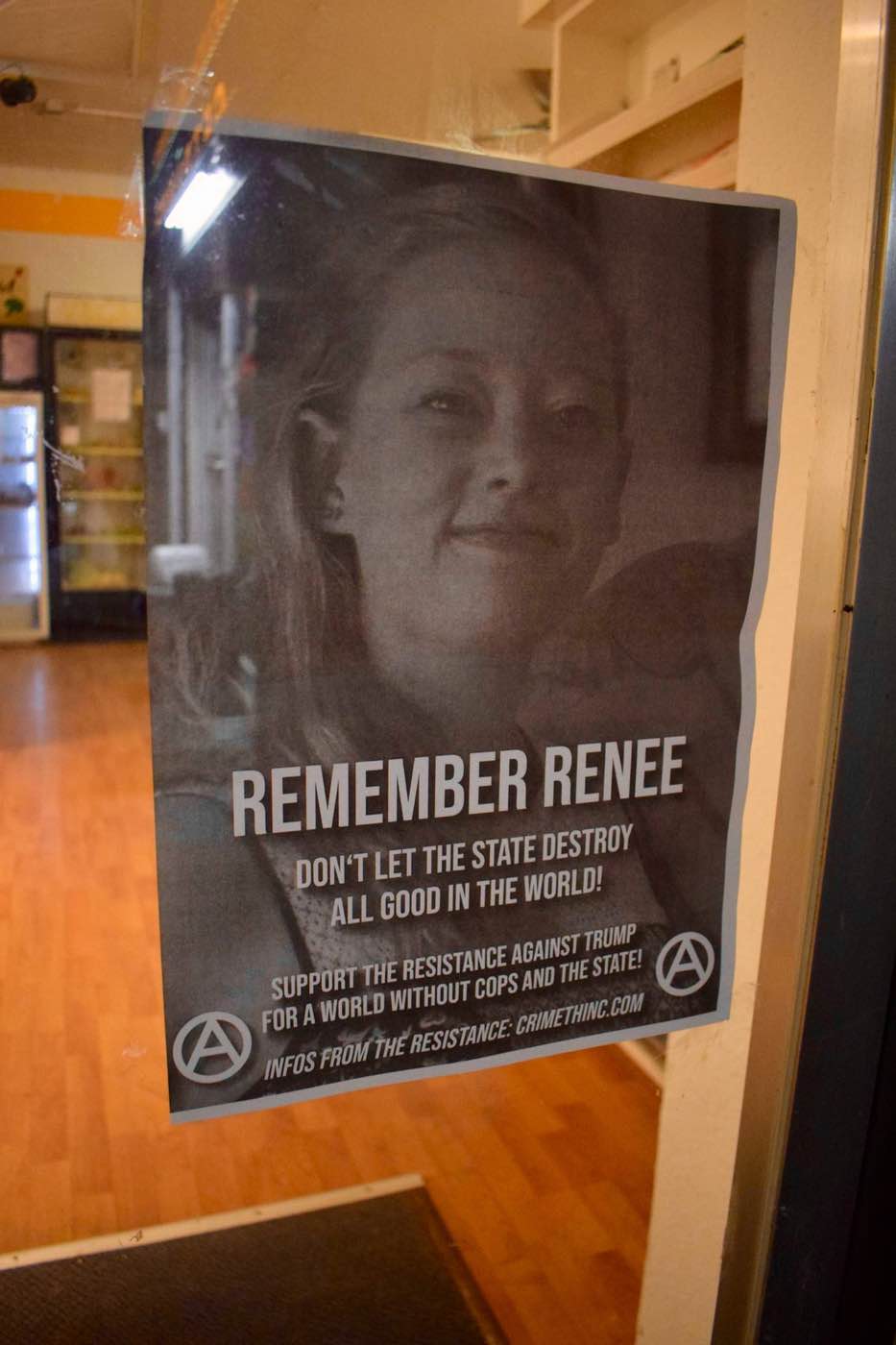
“Remember Renee—Don’t let the state destroy all good in the world.” A poster in remembrance of Renee Good seen somewhere in Germany. You can download the design in Appendix I, below.
Being “Peaceful” and “Law-Abiding” Will Not Stop Authoritarianism
Before the Nazis took power, Germany had one of the largest workers’ movements in the entire world. This movement was dominated by the Social Democratic Party (SPD). From 1919 on, the second strongest power was the Communist Party (KPD). Consequently, the German workers’ movement has always been strongly focused on elections as a means of acquiring state power.
Despite this focus on the parliamentary route, the rank and file of the German workers’ movement has repeatedly been compelled to resort to other means. In 1918, a revolution organized by workers and soldiers overthrew the emperor and created the first German republic, creating a government led by the Social Democrats.
Shortly afterwards, right-wing militias and elements of the official military staged a coup against the government in Berlin. The government fled.
In response, a nationwide general strike took place with millions taking part. In the Ruhr area, workers went a step further: tens of thousands armed themselves and drove the police and military out of the region, establishing workers’ councils. In the cities where the anarcho-syndicalists were strong, people also expropriated companies. The workers were so powerful and the regular German military so weak that the most important industrial region of Germany, a region with millions of inhabitants, was liberated from the control of the state.
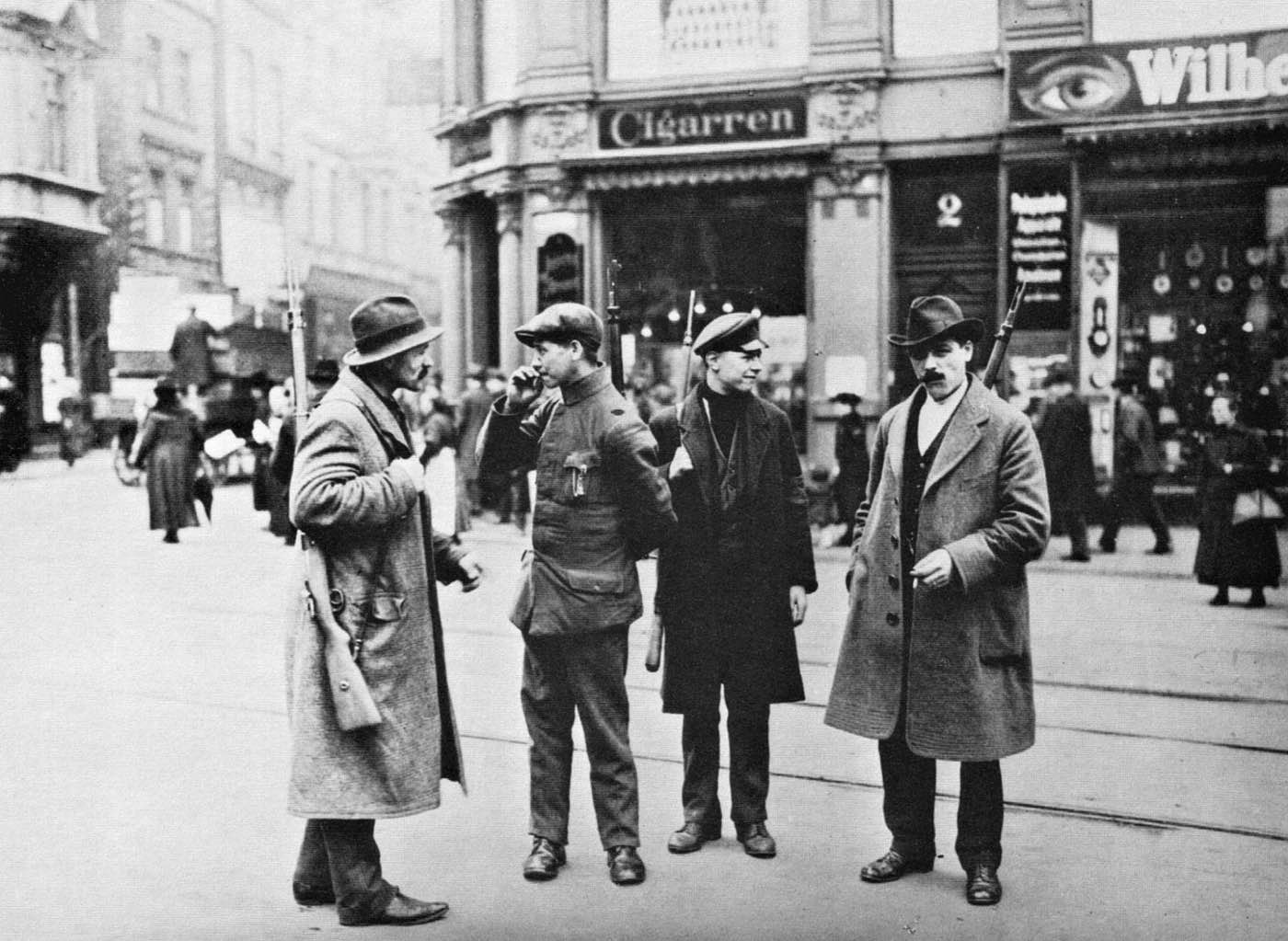
An anti-fascist workers’ militia in the town of Dortmund during the Ruhr Uprising.
After the strikes, direct actions, and militant struggle stopped the coup, the same social democrats that the workers had helped to victory quelled the uprising. To accomplish this, they made use of some of the right-wing militias that had previously been involved in the coup. They were able to do this because half of the workers withdrew from action after the “legitimate” government was back in power.
To crush the Ruhr uprising, state forces murdered over a thousand workers, including many of the most militant fighters of the workers’ movement. Consequently, they were not able to participate in the resistance to the growing fascist movement in the following decade.
Some 93 years after the suppression of the Ruhr uprising, it was the same party, the SPD, that deployed over 31,000 cops to the G20 summit in Hamburg to defend the autocrats Trump, Putin, Erdogan, and Xi.
Today, the SPD is in a coalition with the conservative CDU. Its chancellor, German Prime Minister Friedrich Merz, gives speeches in which he speaks of migrants as “a problem in the cityscape.”
In short, the SPD are to Germany what the Democrats are to the United States. The Democrats, too, are trying to pacify the resistance against Trump in order to maintain their own power.
Without the uprising that took place in 2020, the Democrats likely would not have returned to power. Yet after that uprising, the Democrats sought to eliminate the most militant elements of the resistance via repression while doing their best to re-legitimize the same institutions—such as ICE—that now serve Trump once again.
We do not know how history would have turned out if the workers had not let themselves be divided during the Ruhr uprising—if many of them had not given up as soon as the democratically elected rulers were back in power. But the Ruhr uprising was the best chance to stop the rise of fascism in Germany. After that, no large anti-fascist insurrection took place again.
In the long term, it’s better not to compromise, not to let oneself be pacified and disarmed, whether literally or figuratively. Being uncompromising and taking risks is often safer than restoring the status quo.
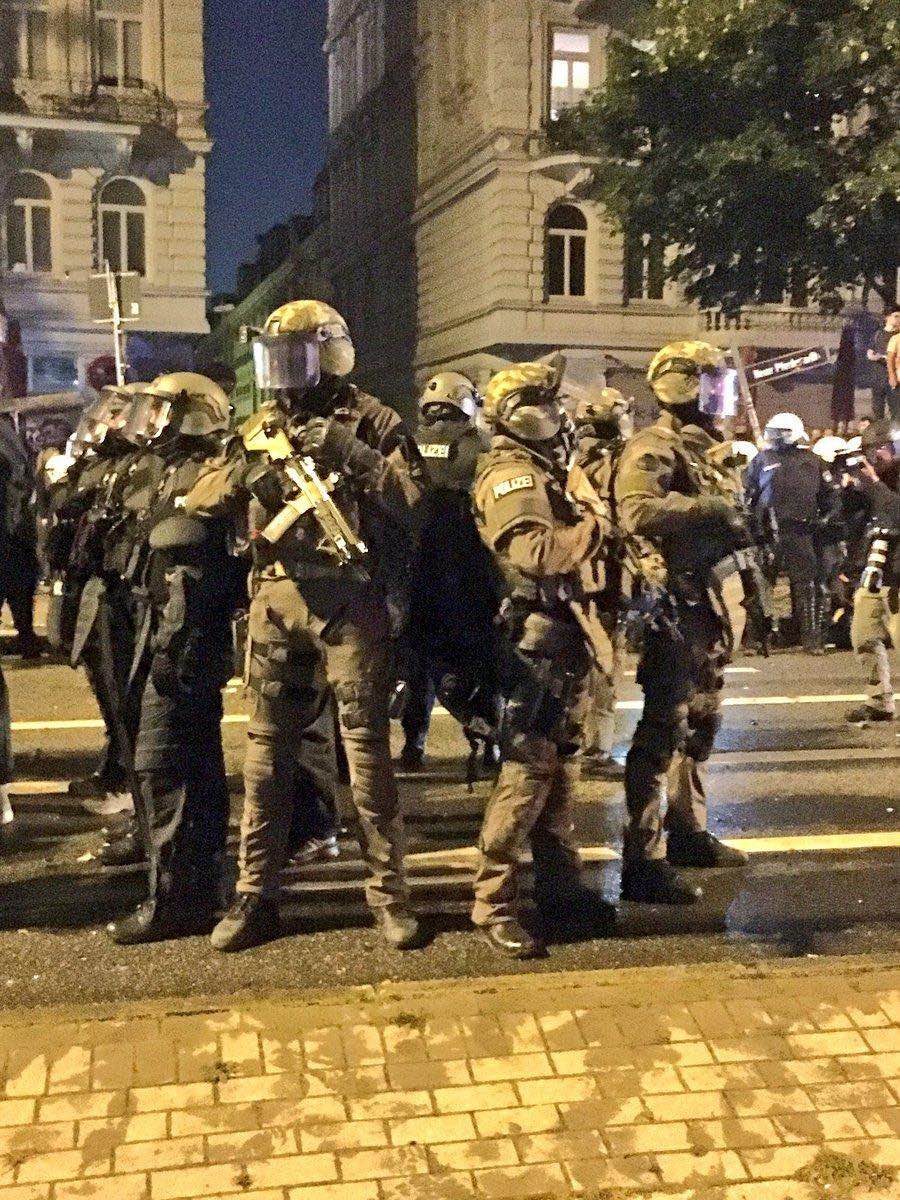
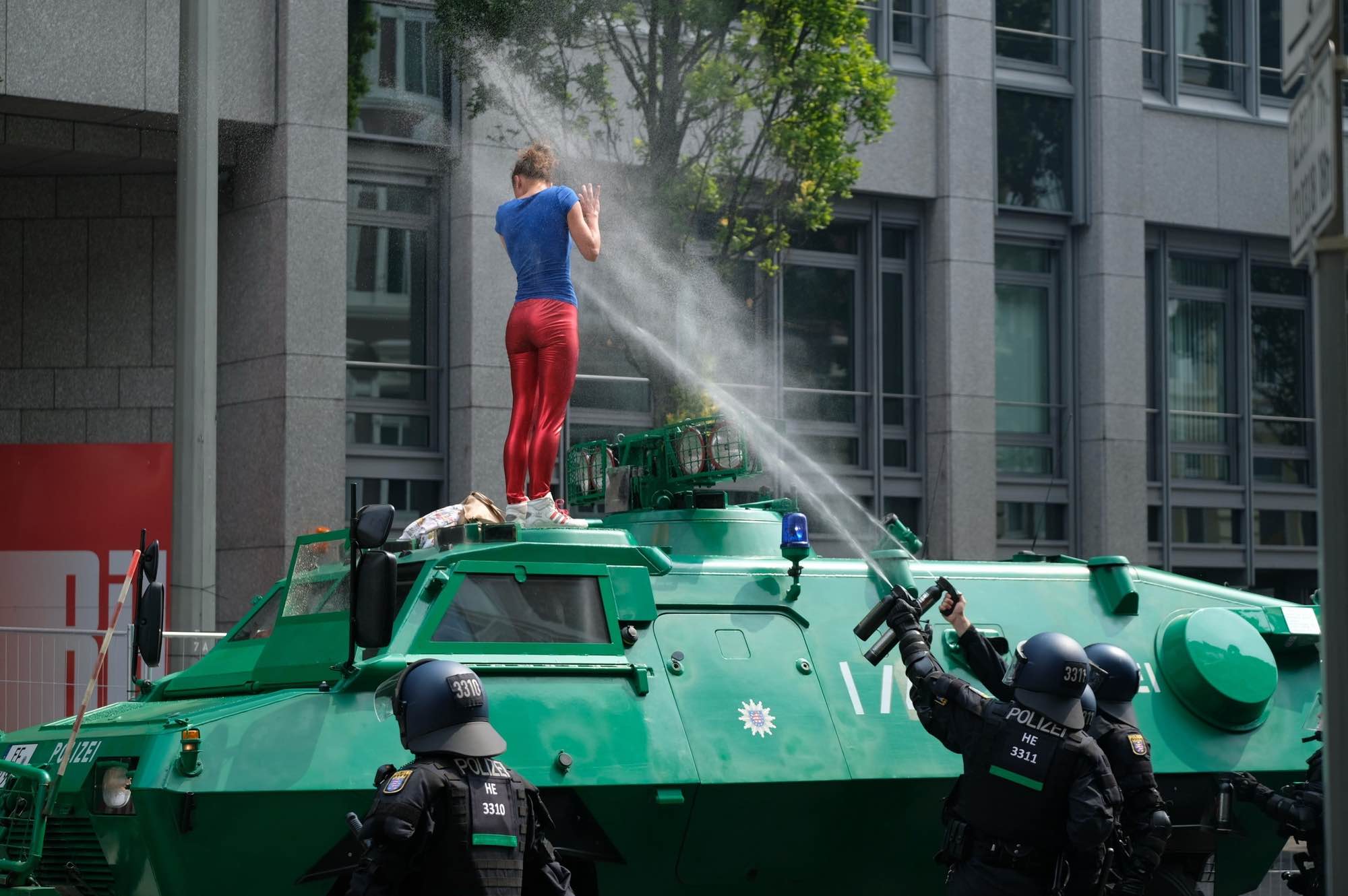
German SWAT police attempting to suppress resistance to the 2017 G20 summit in Hamburg, in order to defend Donald Trump, Vladimir Putin, Xi Jinping, Recep Tayyip Erdoğan, and Saudi Arabian finance minister Muhammad al-Jadaan.
The other lesson that we can draw from German history is that civil war is not the worst thing that can happen. After 1933, there was resistance to fascism in Germany, but the resistance movement was too weak to wage a large-scale struggle like the Ruhr uprising.
By contrast, in countries like Spain and Italy, where the workers’ movement was not dominated by social democrats focused on elections but rather was driven by anarchists and socialists focused on grassroots organizing and action, a long struggle took place against the fascist regimes that came to power, involving extensive resistance.
In the case of Spain, after decades of unauthorized demonstrations, strikes, and militant attacks, the capitalist elite were forced to introduce a democratic system as a concession. The foundation for this extensive resistance had been laid by generations of peasants’ and workers’ resistance from which a great anarchist movement grew, culminating in the anarchist revolution in 1936 and the civil war from 1936 to 1939. Although the anarchists were defeated in the civil war, their efforts left such a mark in Spain that eventually fascism was abolished without the sort of military defeat that was essential to ending fascism in Germany.
To be clear, we do not want a civil war. We want a social revolution—we want people to stand so decisively against the state and capitalism, with such unity, that the other side is too small to wage war at all. But if our only choice is between civil war and a dictatorship that will have a free hand to imprison and murder millions of people, then the decision should be clear. Civil war is better.
Democrats in the United States are trying to stoke fear that “non-peaceful” confrontations with ICE and the Trump regime will lead to the deployment of the military. And then what? People will get shot for protesting? But aren’t people already being shot?
What the Democrats really fear is not that people could be hurt in the streets, but that Democrat politicians might lose their jobs. Because they want to maintain their own power, they try to pacify and divide the resistance with rhetoric about the necessity of remaining “non-violent” and “law-abiding.”
What happens when a population unites against a regime and no longer stops at what is legally permitted? We saw the answer in Germany in 1989 when the GDR (the so-called “German Democratic Republic”) collapsed.
At that time, the resistance to the regime was not all “nonviolent.” There were attacks on the police. The demonstrations were not law-abiding—in fact, they were all illegal. Millions of people broke the law. Because of the number of people on the streets refusing to obey, the regime knew that it would have to use the military, including tanks, to quell the uprising.
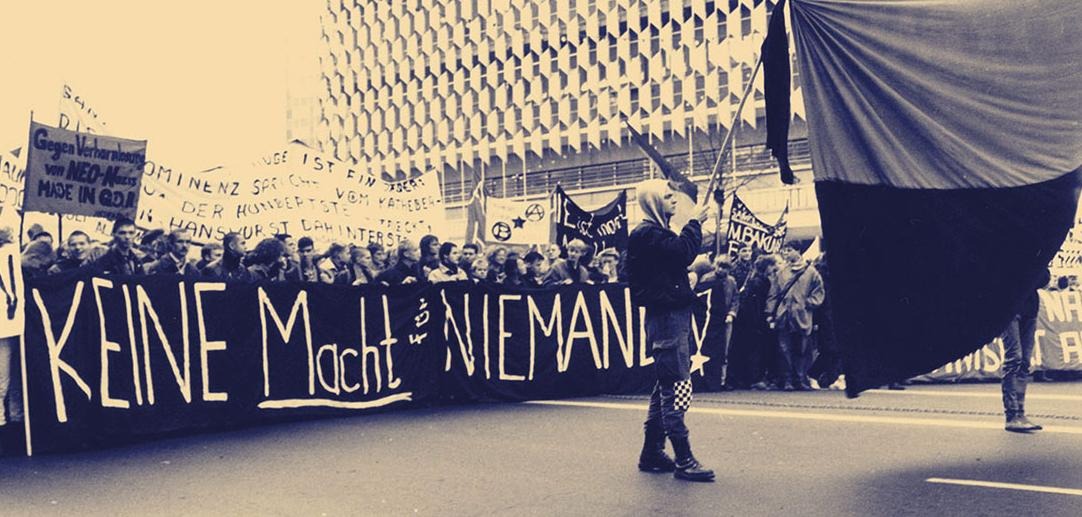
“No Power for nobody”: Anarchists participate in the largest demonstration against the GDR Regime in 1989. Anarchists, especially anarcho-punks and eco-activists, played an important role in bringing down the dictatorship.
Parts of the government became afraid of escalation. They were unsure whether their military was ready to obey the order to attack protesters. They asked their main ally—the Soviet Union—to support them with troops. Soviet leader Mikhail Gorbachev refused.
The Trump regime is not dependent on Moscow, at least not in this particular way. But it relies on an American state apparatus that is not entirely under its control.
As long as the Trump regime is not forced to use the military and all other available forces, as long as the loyal shock troops of ICE suffice to enable them to accomplish their goals, those who are not yet definitively on Donald Trump’s side will not have to make a decision. They will not have to experience a Gorbachev moment in which they might decide against carrying out Trump’s orders.
Escalation always involves the risk of losing. But holding back in this situation means choosing to lose.
The downfall of the GDR also shows that it is not necessarily useful to address resistance directly to the despot, as he will not be the one who hesitates, but rather to those who are not completely ideologically on his side.
In the context of the United States, this would mean not to focus all energy on ICE and Trump. It is important to oppose them, but that will go much better if every time Democrat politicians send local and state police and National Guard to protect ICE, they experience consequences that make it impossible for them to continue to do so.
The uprising in the GDR did not succeed in a vacuum. In many countries in Eastern Europe, the heads of numerous dictatorships were forced to decide whether to double down on repression or make concessions. Any weakening of the dictatorship in a neighboring country made it possible to expand the fighting elsewhere, because it was no longer possible to move troops from one Warsaw Pact state to another.
We want to propose a question. What would it take to ensure that a mayor in the USA can no longer send the police when people try to confront a hotel full of ICE agents? What has to happen to compel a governor to order his National Guard not to interfere? What circumstances would have to prevail on the street to make it impossible for the National Guard of one state to be sent in another?
It’s Too Late to Preserve the Status Quo
While fascists and autocrats are not yet in power in Germany, the day when they could be is not far away. The AFD (Alternative for Germany) is about to become the strongest party in Germany. The AFD represents positions similar to the MAGA movement, and the demographics that support them are similar.
While it has a clearly fascist base, most people do not vote for the AFD because they support its positions. As surveys show, they vote AFD to express their anger at the existing system. Consequently, the AFD is now especially successful in the Ruhr area—the region where the largest anti-fascist uprising in German history took place in 1920—as well as in East Germany. This is not a coincidence. After the people in Ruhr area mined coal for 100 years to support German industry and German wars, the region was left impoverished the way that the Rust Belt in the United States has been since the 1970s.
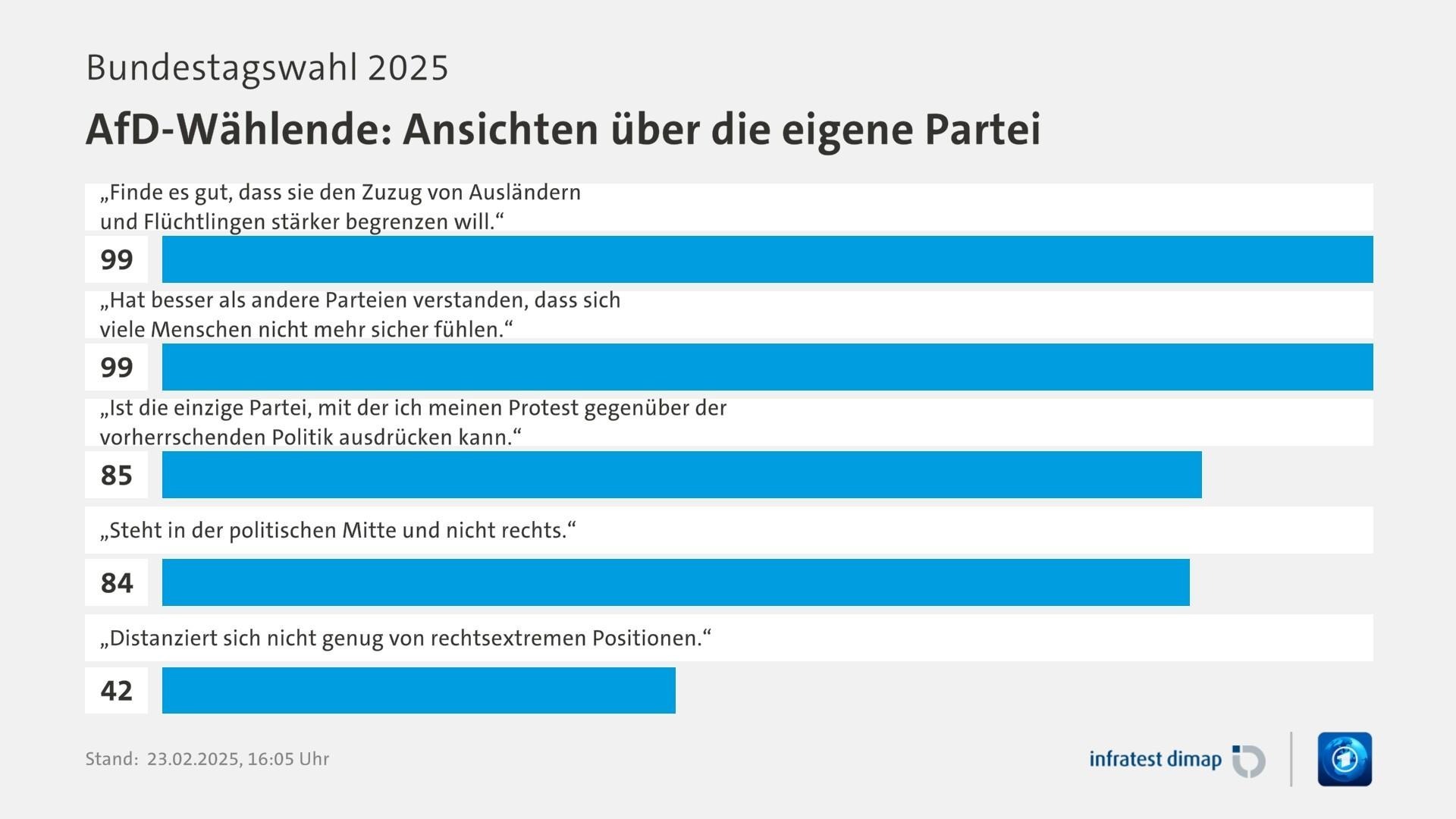
A survey of AFD voters in February 2025, in which 85% of them claimed that the AFD was the only political party via which they could express their protest.
And who was responsible for this? The SPD—the social democrats who managed the process of economic decline for 50 years while diligently profiting from their posts in the state apparatus until the situation finally became so stark that they could not maintain their majorities.
And here we find another parallel: just like Trump, the AFD does not promise material improvements to its base; rather, it promises hatred and violence. It will not benefit the majority of its constituents. The AFD openly states in its election program that it intends to cut German social spending, just as the Republicans are doing under Trump. Its leaders are primarily recruited from the academic elites; they are not the ones who are at risk from these cuts.
The neoliberal left (SPD) and the conservatives (CDU) who are currently in power in Germany have already partially implemented these cuts on the grounds that doing so would stop the AFD from gaining support. Unsurprisingly, this has done nothing to erode the popularity of the AFD. These neoliberal leftists and conservatives are comparable to the right wing of the US Democrats.
The only other notable political force in Germany is the Left Party, which now represents the new Social Democracy. It’s clear where this will end up. In the neoliberal global order, and due to the decline of the imperialist rule of Europe, the Left Party will not be able to carry out significant social reforms. Like Syriza, it will betray its predominantly young voters—this has already been shown in the decision to abstain from the vote on a pension package, which allowed the law to pass. (At the expense of the younger generations, this pension package preserves the status quo of the state pension without compelling privileged groups—such as Beamte, a special group of state employees, entrepreneurs, and self-employed people such as doctors—to pay into the general pension system.)
To summarize: just as in the United States, where the Democrats do not represent a real alternative to Trump and cannot stop the fundamental causes of authoritarianism, in Germany, there is no real alternative to be found within the state.
The only way out would be a movement that overturns the fundamental power structure of society, putting an end to the state and capitalism. Unfortunately, the prospects for this in Germany are currently very weak.
The Resistance to Trump Is Our Best Hope
In view of all these factors, we could be reduced to despair, but actually, we are still capable of hope. We are able to hope because we have experienced that what is happening in the United States can spill over to Germany. Inspired by the George Floyd uprising, tens of thousands in Germany spontaneously took to the streets against the violence of the police in the summer of 2020—something that has not happened in Germany for decades, because, thanks to their “good training” see Appendix II, the police rarely kill white people from the middle class. Summer 2020 was one of the few moments in the past decades when, for a moment, something other than the status quo seemed possible.
After that, protests continued against police murders, although—being organized by an alliance of liberals, social democrats, and parts of the so-called “radical left”—they were mostly directed at securing the convictions of the policemen involved. As in the United States, this strategy has failed utterly. Instead of becoming more “accountable,” police are expanding their powers in Germany, including the use of Tasers, AI-based surveillance, and the installation of monitoring software.
But if people in the US succeed in stopping Trump and the resistance that unfolds exceeds the control of Democrat politicians, if something better than the old status quo becomes possible, that will also inspire people in Germany and all around the world.
That is why we want to call on everyone in the territory claimed by Germany to support the resistance against Trump.
The only route that promises long-term security is the route to another world.
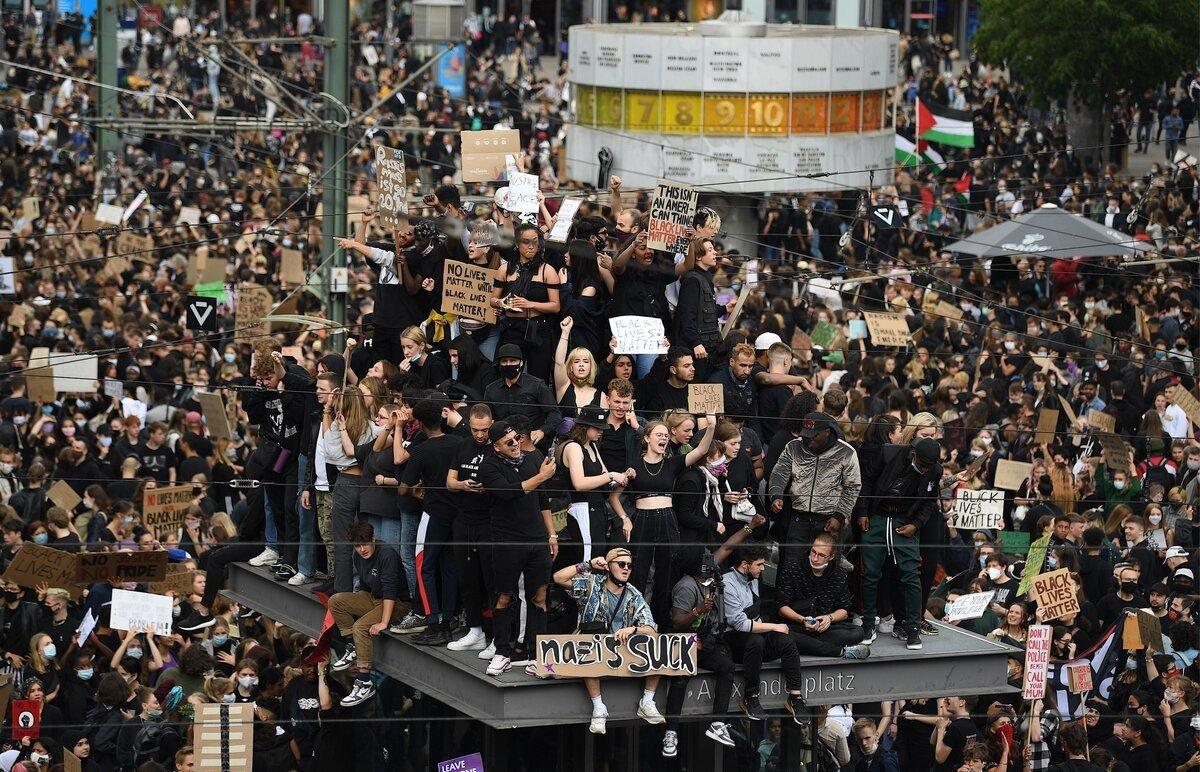
15,000 people protest in solidarity with the George Floyd Uprising on June 6, 2020 in Berlin.
Appendix I: A Poster in Memory of Renee Good
After seeing the above photograph of this poster hanging in Germany, we’ve succeeded in acquiring a PDF of it, which you can download here.

Click on the image to download the PDF.
Appendix II: Better-Trained Cops Don’t Stop Killing
In their attempts to pacify resistance to the Trump regime, Democrats promote the narrative that a “better trained” police force would be less violent.
The example of the German police shows that this is false. German police are among the most highly trained in the world. German officers receive two and a half or even three years of training. They receive training in deescalation and communication. This does not prevent them from murdering people.
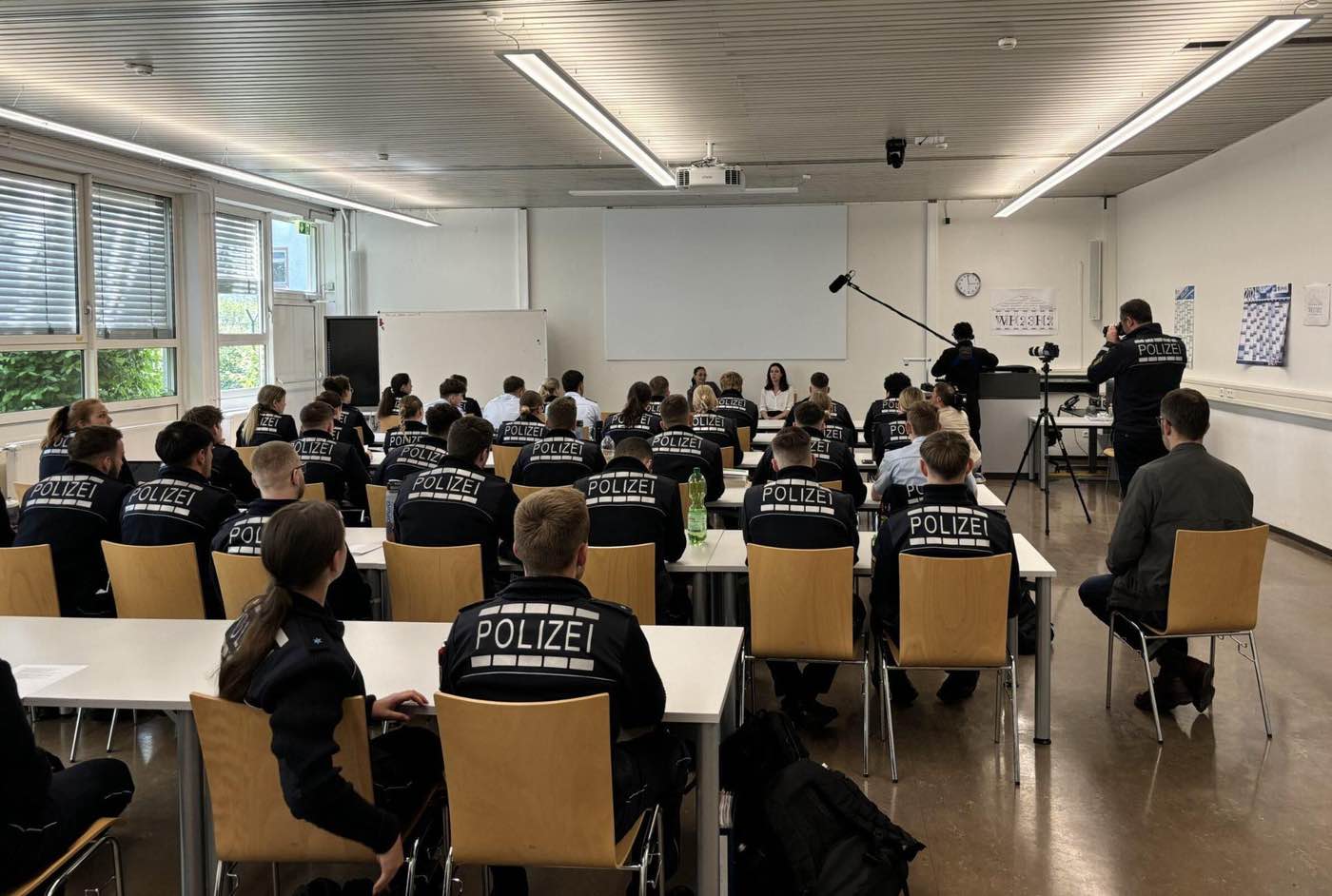
German police receiving training about racism against Sinti and Romani people.
A well-trained police force does not create more freedom and security. It creates a stronger state. It is precisely this “strong” state that has repeatedly made great horrors possible in German history.
In 2024, police in Germany shot and killed 22 people. For comparison, if the population of Germany were equivalent to the population of the United States, this would mean that German police killed approximately 100 people. In the United States, police kill over 1000 people a year, but the figures in Germany do not include those who have been killed by the police in other ways—there are no central statistics about the total number of police murders in Germany, just as there were no public statistics about police murders in the United States until fierce demonstrations brought the subject to light. Firearms are much harder to come by in Germany, yet the police still kill people, even without that justification.
In any case, despite all the training, the number of people that police shoot in Germany is increasing.
Are police less likely to do violence to people because they are trained to “help” them? Consider the case of a deaf 12-year-old, whom police shot on the night of November 16, 2025. The police were sent by the youth welfare office because the 12-year-old had left a residential group of the youth welfare office to visit her family. Shortly after midnight, several police officers broke into the family’s home, pulled the mother, who was also deaf, out of the apartment, and shot the 12-year-old with both a pistol and a Taser. The child survived, though critically injured. The police claim that the 12-year-old had a knife in her hand. If she really did have a knife in her hand, it was a spontaneous attempt to defend her family against the violence of the state.
The reasoning of the police for the operation was that the twelve-year-old urgently needed insulin and therefore had to intervene. The logic is that the state must protect people from themselves by force, must violently rule them for their own good. Training is not the issue here. The problem is the monopolization of force by an institution that exists for the sake of using violence against the general public.
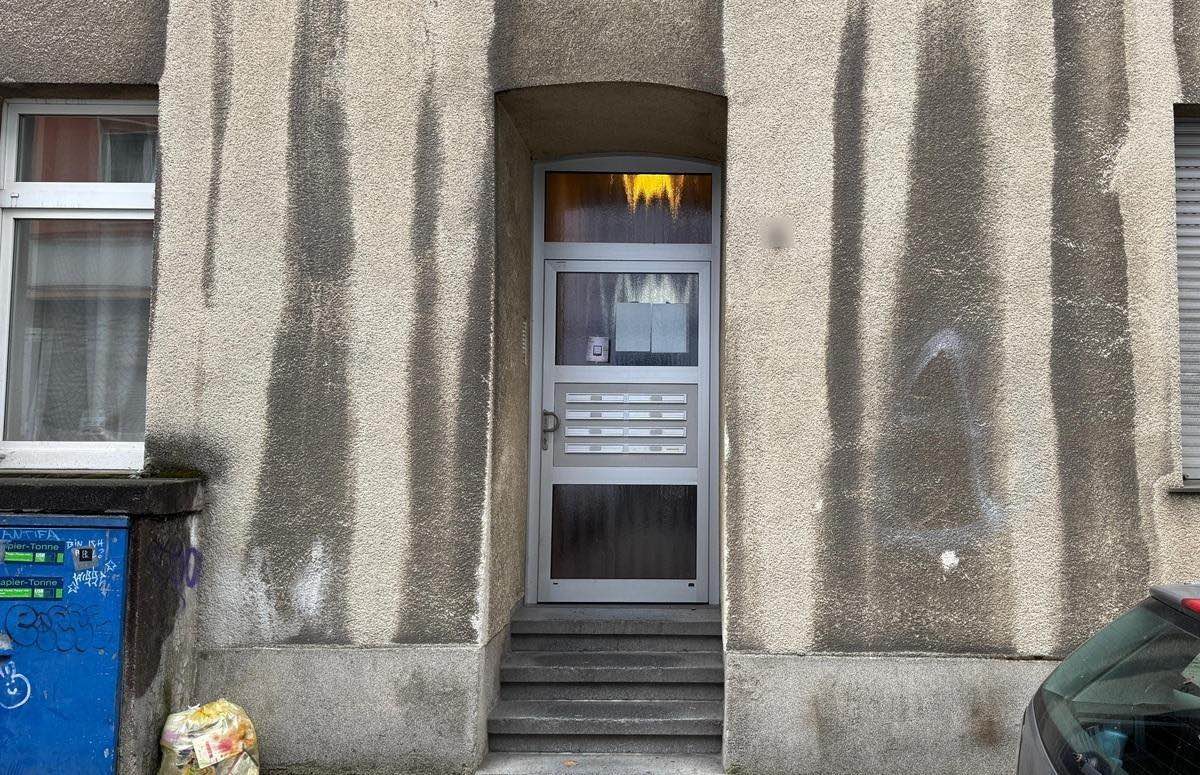
The entrance to the apartment building where German police shot a 12-year-old girl on November 16, 2025. It is located in Hamme, a working class neighborhood in the town of Bochum in the Ruhr Area.